FSSAI Compliance for Retort Processing in Maharashtra — What Food Manufacturers Must Know
If you are operating or setting up a retort food processing unit in Pune, Mumbai, Nashik or anywhere in Maharashtra, FSSAI compliance is not optional — it is a legal requirement and a commercial necessity.
FSSAI (Food Safety and Standards Authority of India) regulates thermally processed food under specific regulations that govern everything from your retort machine’s operating parameters to your packaging, labelling, and microbial testing protocols.
This guide, written by the engineering team at RP Electrical Engineers (retort machine manufacturer, MIDC Bhosari, Pune), explains what Maharashtra food manufacturers need to know about FSSAI compliance for retort processing — without the bureaucratic jargon.
What is FSSAI and Why Does It Matter for Retort Processing?
FSSAI is India’s apex food safety regulatory body, established under the Food Safety and Standards Act, 2006. For retort-processed food manufacturers, FSSAI compliance matters because:
- Mandatory licensing: Any food manufacturer in India producing packaged food for commercial sale must hold a valid FSSAI Central License or State License
- Legal protection: A compliant retort process protects you from liability in case of a food safety incident
- Market access: Modern retail chains, e-commerce platforms, and institutional buyers require FSSAI-compliant products
- Export eligibility: Indian retort-processed food exported to the EU, USA or Middle East must meet both FSSAI standards and the destination country’s food safety regulations
Key FSSAI Regulations Applicable to Retort Processing
Food Safety and Standards (Food Products Standards and Food Additives) Regulations, 2011
This regulation defines quality and safety standards for thermally processed food. Key requirements include:
- Products must be commercially sterile (absence of viable pathogenic microorganisms)
- Processes must be validated to achieve the required F₀ value
- Low-acid foods (pH above 4.6) must be processed at 121°C or achieve an equivalent lethality
Schedule 4 of FSS (Licensing and Registration) Regulations
For retort processing facilities in Maharashtra, Schedule 4 sets out the specific infrastructure, equipment, and documentation requirements for obtaining and maintaining an FSSAI Central License.
Key requirements under Schedule 4 for retort processors:
- Calibrated temperature and pressure instruments on the retort machine
- Process logs for every batch (time, temperature, pressure, come-up time)
- Trained operators who understand thermal processing principles
- Scheduled process validation by a recognised process authority
Understanding the F₀ Value — The Core of Retort Food Safety
The F₀ value is the central concept in retort food safety. It measures the total heat treatment received by the product, expressed as equivalent minutes at 121.1°C (250°F).
Why it matters: The target pathogen in low-acid retort processing is Clostridium botulinum, the bacterium that produces botulism toxin. FSSAI requires that the thermal process delivers sufficient lethality (measured as F₀) to make the product commercially sterile.
Minimum F₀ value: For low-acid foods (pH > 4.6, water activity > 0.85), a minimum F₀ of 3 minutes is the standard starting point. However, the actual target F₀ for a specific product may be higher depending on the product’s density, can/pouch size, and heat penetration characteristics.
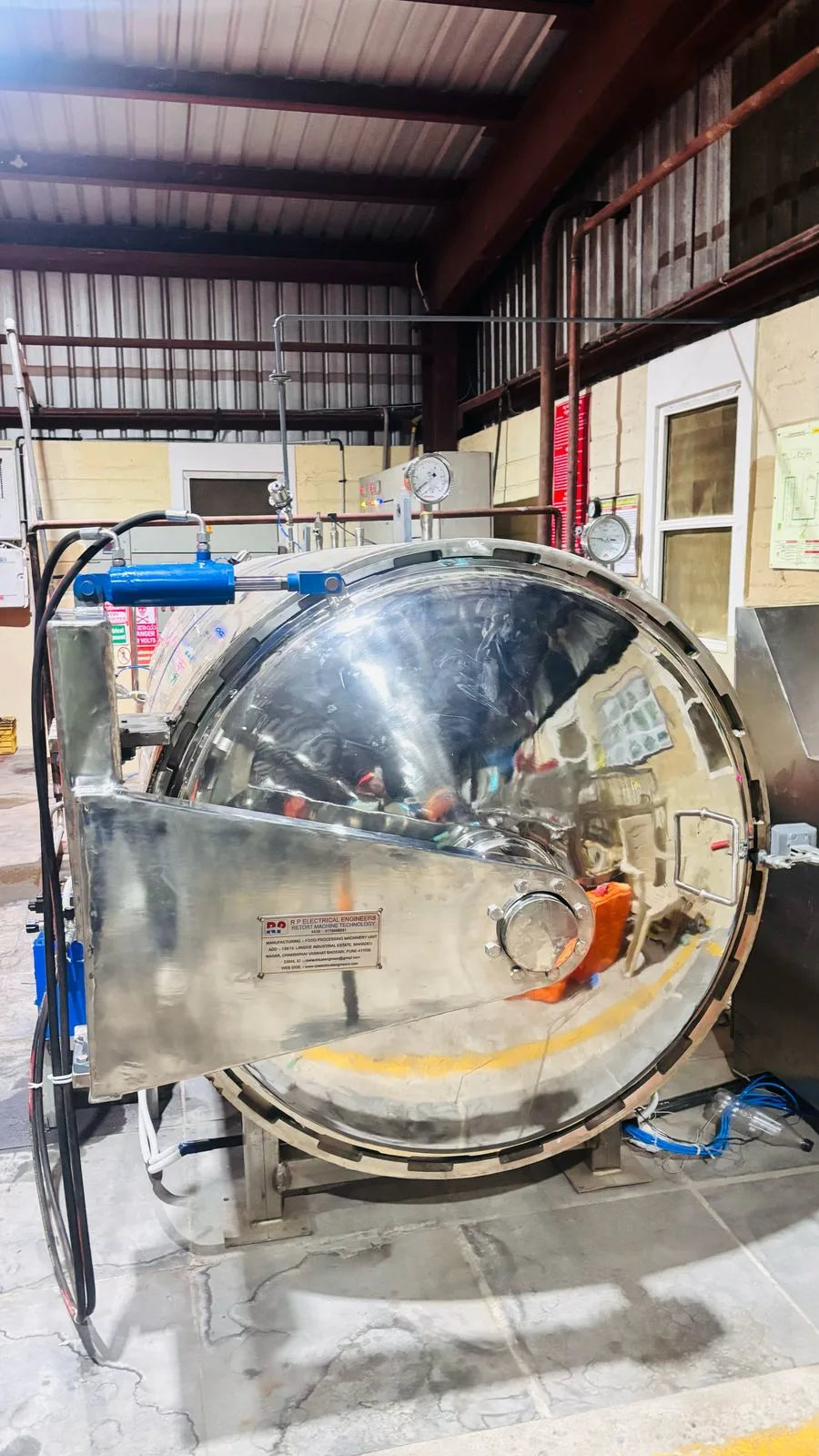
How your retort machine delivers F₀: A properly set up retort machine from RP Electrical Engineers maintains the sterilization temperature (typically 121°C) for the prescribed hold time, ensuring the slowest-heating point in every package receives the minimum required lethality.
Thermal Validation — Mandatory Before Commercial Production
Thermal validation (also called process validation or heat penetration study) is the scientific process of proving that your retort schedule achieves the required F₀ value in the slowest-heating unit in the most difficult-to-heat location in your retort.
How Thermal Validation Works
- Heat penetration study: Thermocouples are placed at the slowest-heating point (usually the geometric centre) of the package. Temperature data is recorded throughout multiple retort cycles.
- F₀ calculation: The F₀ value is calculated from the recorded temperature data. If it meets the target, the schedule is validated.
- Process authority sign-off: A recognised process authority (a food scientist or institution with expertise in thermal processing) reviews the data and approves the scheduled process.
- Scheduled process document: The validated process is documented as a scheduled process — this document must be maintained on file and followed without deviation during production.
Packaging Requirements for FSSAI-Compliant Retort Products
Retort Pouches
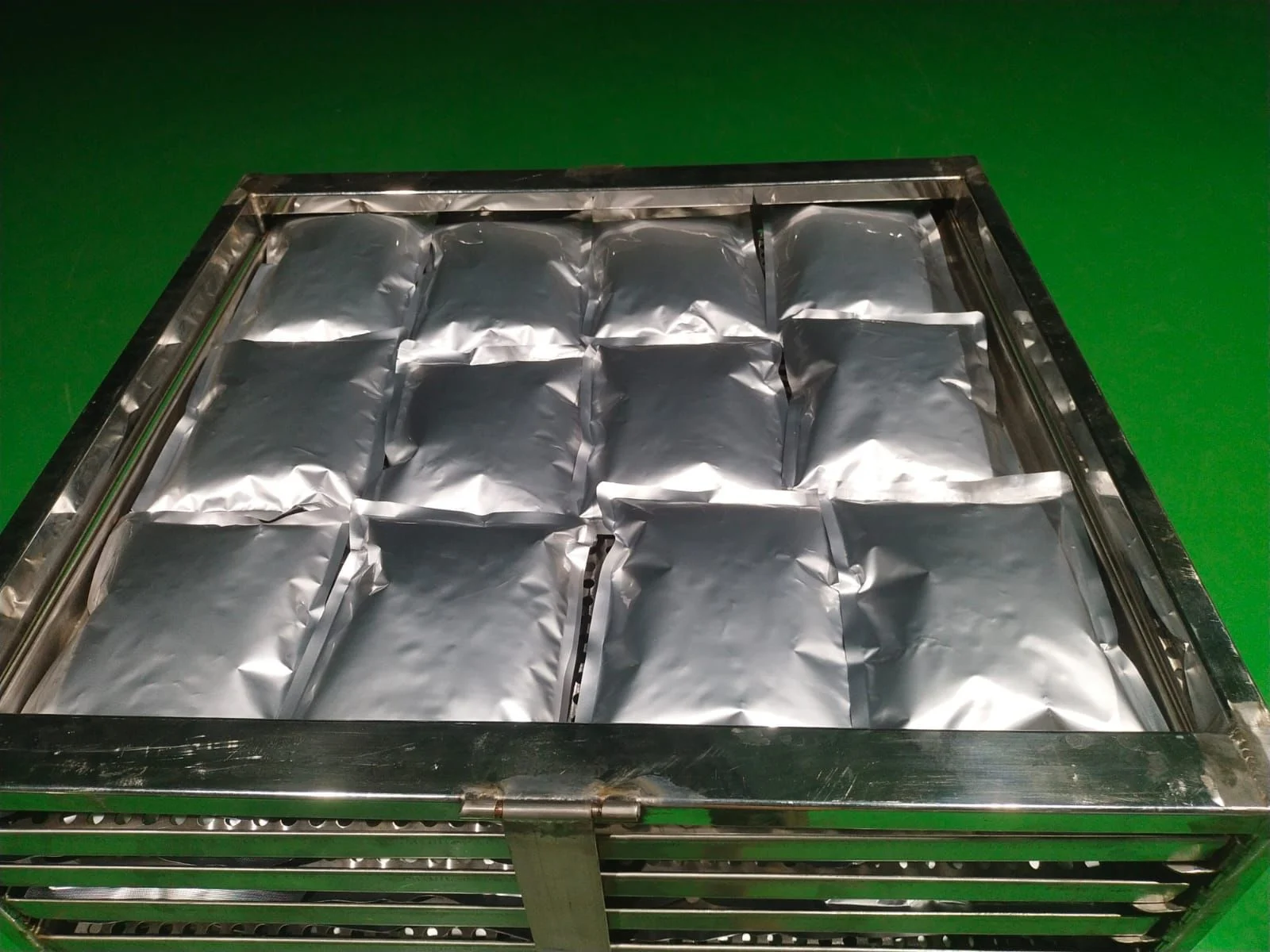
- Must be made from food-grade laminates approved for retort conditions (typically PET/Al/CPP or Nylon/Al/CPP structure)
- Must withstand 121°C and the overpressure conditions inside the retort
- Seal integrity must be validated and tested regularly
Tin Cans
- Must be food-grade tinplate or aluminium
- Double-seam integrity must be verified before and after retorting
- Internal lacquer must be suitable for the product type (high-acid or low-acid)
Labelling Requirements
- FSSAI License Number must appear on every pack
- Net weight, batch number, date of manufacture, best before date mandatory
- “Retort Processed” or “Thermally Processed” declaration recommended
- Storage instructions if any
Batch Record Keeping — Non-Negotiable for FSSAI Compliance
Every retort batch must have a complete batch record containing:
- Date and time of processing
- Batch number and product name
- Initial temperature of the product
- Come-up time (time to reach sterilization temperature)
- Sterilization temperature (must match validated scheduled process)
- Hold time at sterilization temperature
- Cooling method and time
- Operator signature
- Any deviations from the scheduled process and corrective action taken
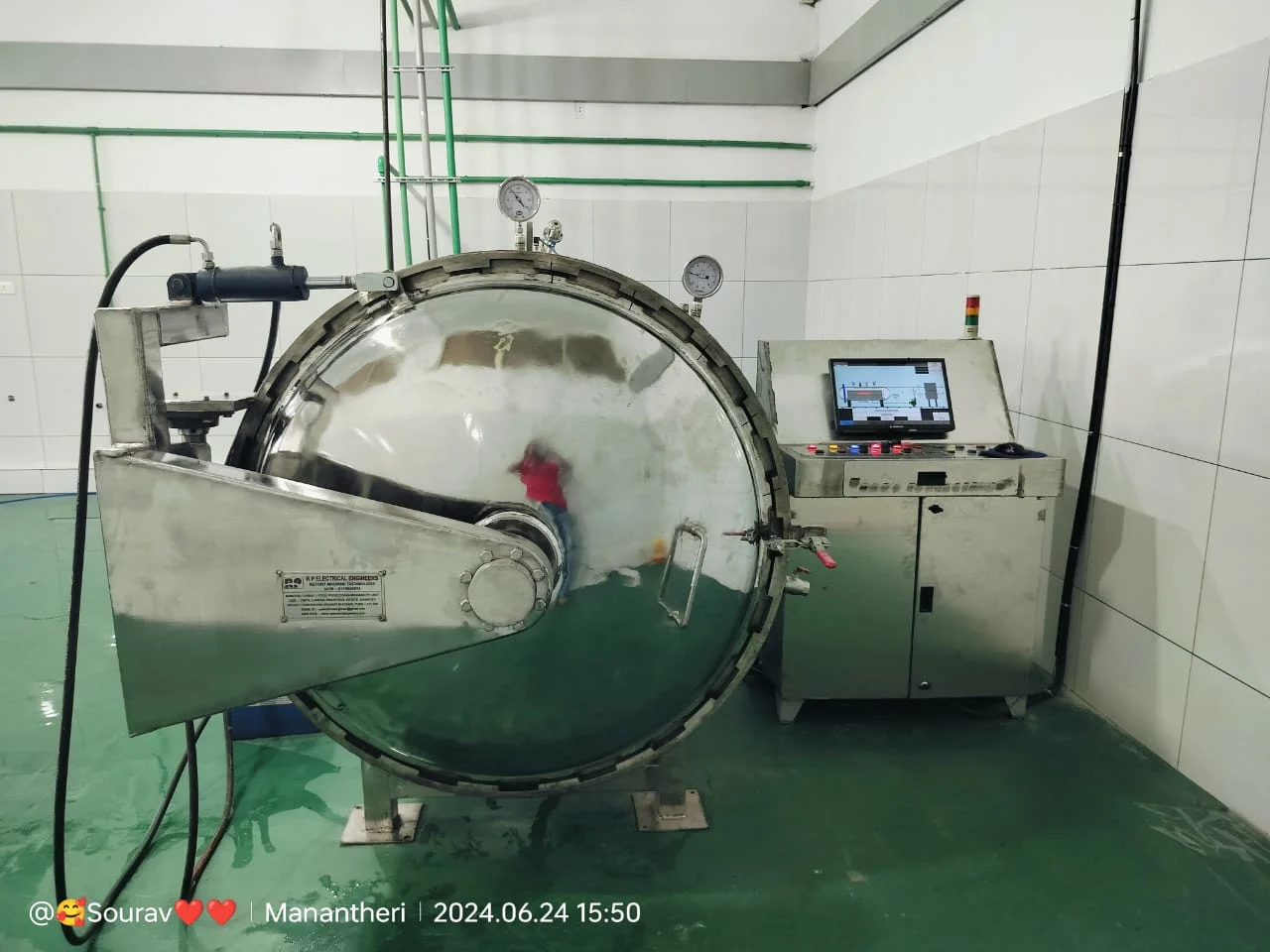
Retort machines supplied by RP Electrical Engineers include automated data logging systems that record temperature and pressure throughout the cycle, simplifying batch record documentation for FSSAI compliance.
Common FSSAI Compliance Mistakes by Maharashtra Food Processors
Using an unvalidated retort schedule: Processing food without a properly validated scheduled process is a critical FSSAI violation and a serious food safety risk.
Running the retort at a temperature below the validated schedule: Even a 1°C drop in sterilization temperature can significantly reduce F₀ value. Always use a calibrated, accurate retort machine.
Inadequate seal testing: Pouch seal failures after retorting lead to product recalls and FSSAI penalties. Test seal integrity on every batch.
Poor batch record maintenance: FSSAI inspectors check batch records during audits. Incomplete records can result in license suspension.
Skipping re-validation after process changes: Any change in product formulation, pouch size, fill weight, or retort load configuration requires re-validation of the scheduled process.
How RP Electrical Engineers Supports FSSAI Compliance for Maharashtra Food Processors
When you purchase a retort machine from RP Electrical Engineers in Pune, you are not just buying equipment — you are getting a compliance-ready system:
- Calibrated instruments: All temperature and pressure gauges are factory-calibrated and supplied with calibration certificates
- Automated data logging: PLC-based control systems record every process parameter automatically
- Operator training: We train your team on retort operation, process monitoring, and batch record keeping
- Process documentation support: We help you prepare the technical documentation required for FSSAI license applications related to your retort equipment
- Overpressure-capable systems: Critical for pouch retorting to maintain package integrity during processing
Frequently Asked Questions
Do I need FSSAI Central License or State License for retort processing in Maharashtra?
If your annual turnover exceeds ₹20 crore, or if you are manufacturing and distributing across state borders, you need an FSSAI Central License. Most commercial retort processors in Maharashtra require a Central License.
How often do I need to re-validate my retort process?
FSSAI does not specify a fixed re-validation interval, but industry best practice is to re-validate every 3–5 years or whenever there is a change in product, packaging, fill weight, or retort loading configuration.
Can RP Electrical Engineers help me get my retort machine certified for FSSAI purposes?
We supply machines with calibration certificates for all instruments. We can also provide technical documentation about the machine’s operating parameters to support your FSSAI license application. Final process validation must be conducted by a recognised process authority.
What happens if my retort batch fails to reach the required F₀ value?
This is a process deviation. The batch must be quarantined and re-processed or destroyed. The deviation must be documented in the batch record. RP Electrical Engineers’ PLC systems can be configured to alarm automatically if temperature or pressure deviates from the scheduled process.
Explore Our Retort Machine Solutions
Interested in our retort machines? Explore our pouch retort machine in Pune, water spray retort machine, and canning retort machine offerings. Ready to discuss your project? get a free quote today.
Related RP Electrical Resources
Explore these related solutions and guides from RP Electrical Engineers: