Shelf Life Extension for Packaged Food in Maharashtra — How Retort Sterilization Makes It Possible
For a food manufacturer in Maharashtra — whether you are producing ready-to-eat curries in Pune, coconut water in Ratnagiri, or canned sweet corn in Nashik — shelf life is everything.
A product with a 2-day shelf life is a local business. A product with a 24-month shelf life is a national brand.
Retort sterilization is the technology that bridges that gap. And RP Electrical Engineers, based at MIDC Bhosari in Pune, has been helping Maharashtra food manufacturers make that transition since 2010.
This guide explains the science of shelf life extension through retort sterilization, what it means for your product quality, and how to implement it correctly at your Maharashtra food processing facility.
Why Food Spoils — The Enemy List
To understand how retort sterilization extends shelf life, you first need to understand why food spoils. There are four main spoilage mechanisms:
1. Microbiological Spoilage
Bacteria, yeasts, and moulds grow on food and produce toxins, gas, and off-flavours. The most dangerous is Clostridium botulinum, which produces a potentially lethal toxin in low-acid, sealed food products at room temperature.
2. Enzymatic Activity
Plant and animal tissues contain natural enzymes that continue to act after harvest or slaughter, causing browning, texture changes, and flavour degradation.
3. Chemical Oxidation
Fats and pigments react with oxygen, causing rancidity and colour changes.
4. Physical Changes
Moisture migration causes staling, sogginess, or crystallisation.
Retort sterilization directly addresses the first two — and partially the third — by applying controlled heat that destroys microorganisms and inactivates enzymes.
How Retort Sterilization Extends Shelf Life
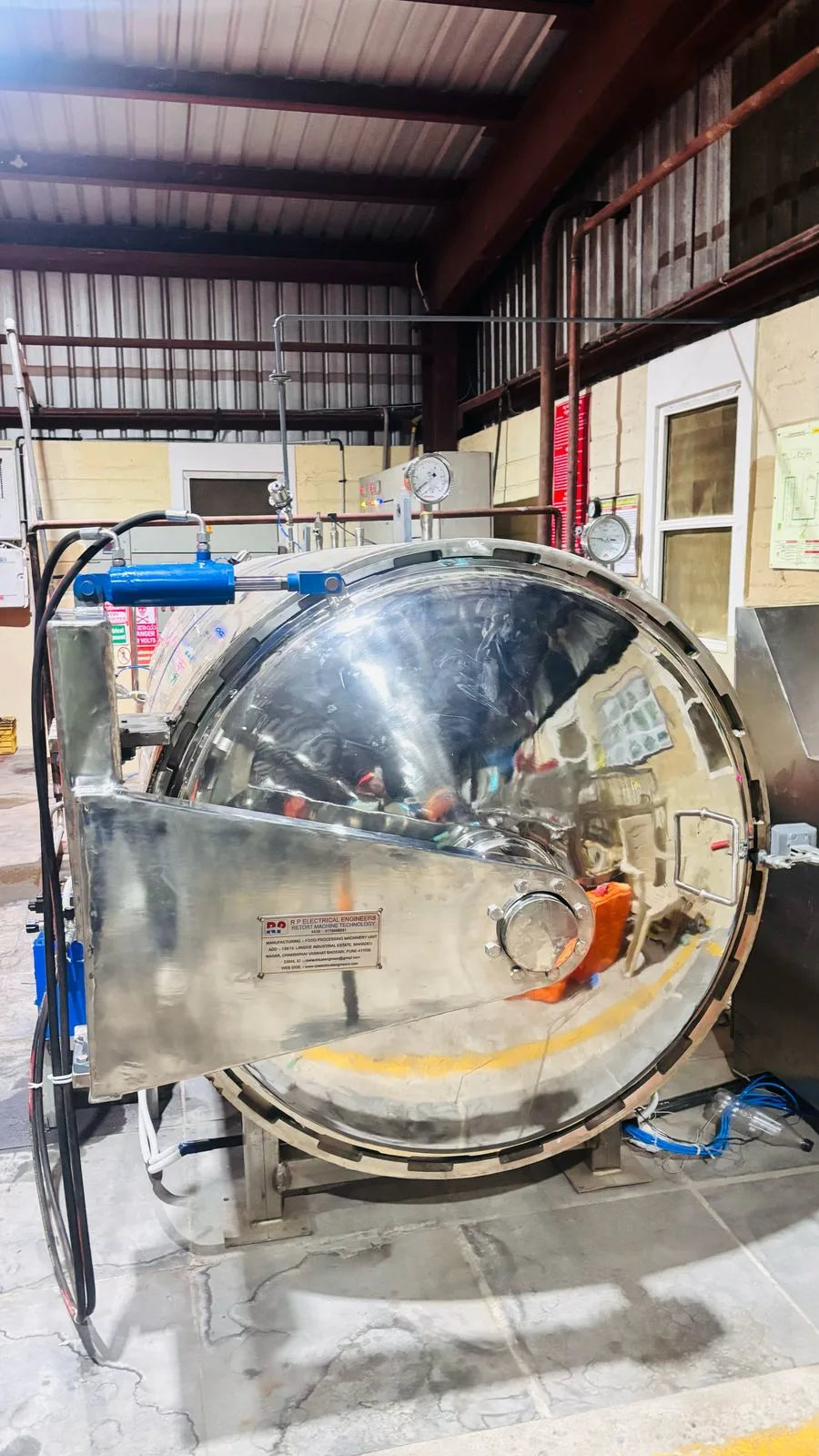
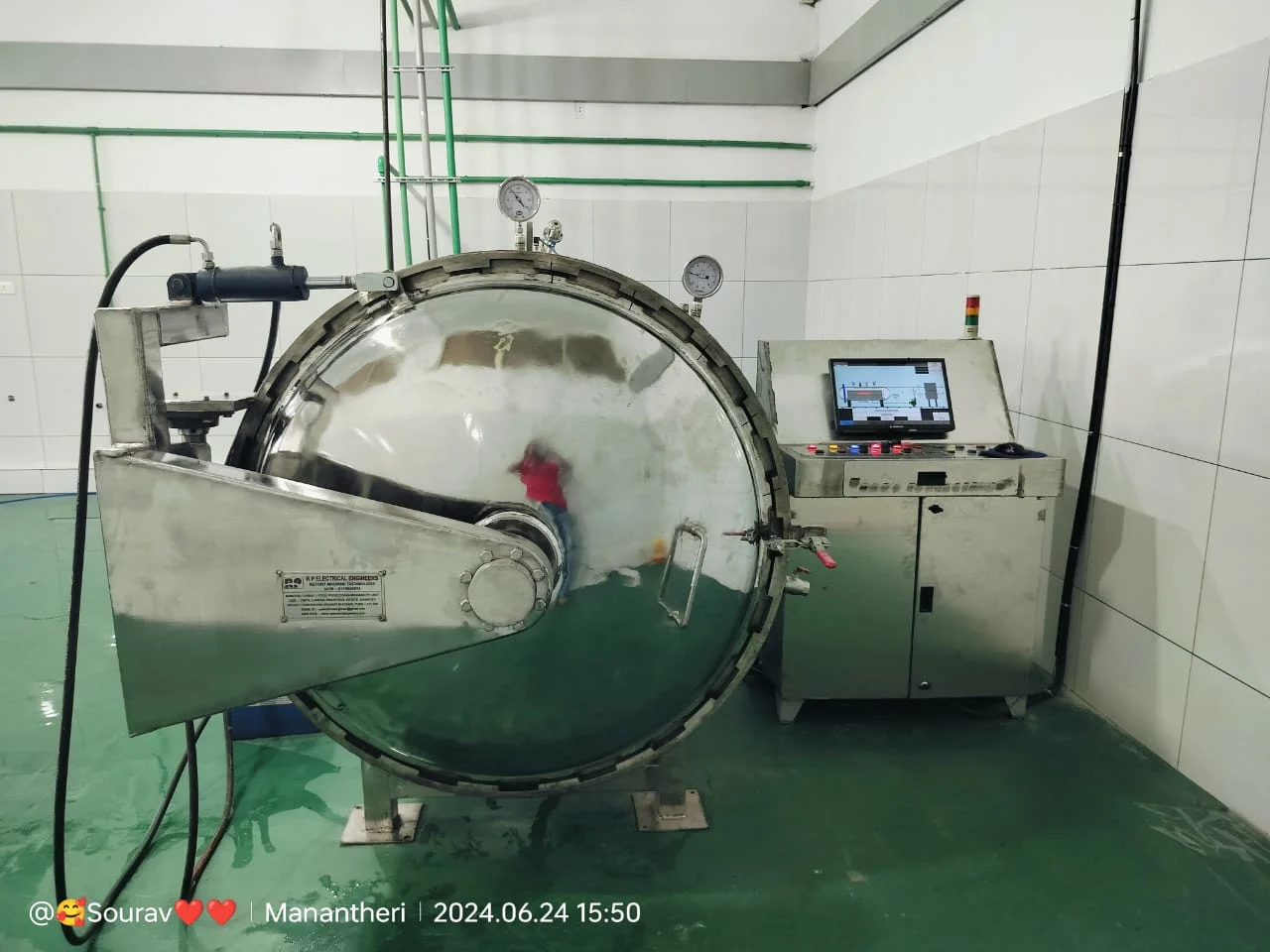
A retort machine works by heating sealed, packaged food inside a pressurised vessel to temperatures between 110°C and 125°C, held for a calculated time period, then cooling under controlled pressure.
This process achieves two things simultaneously:
Commercial sterility: All viable pathogenic microorganisms and spores are destroyed. The product is free from organisms capable of causing food-borne illness or spoilage under normal storage conditions.
Enzyme inactivation: The heat treatment inactivates endogenous enzymes that would otherwise continue to degrade the product’s colour, texture, and flavour.
The result is a product that is shelf-stable at ambient temperature — no refrigeration needed — for 12 to 36 months depending on the product type, packaging, and storage conditions.
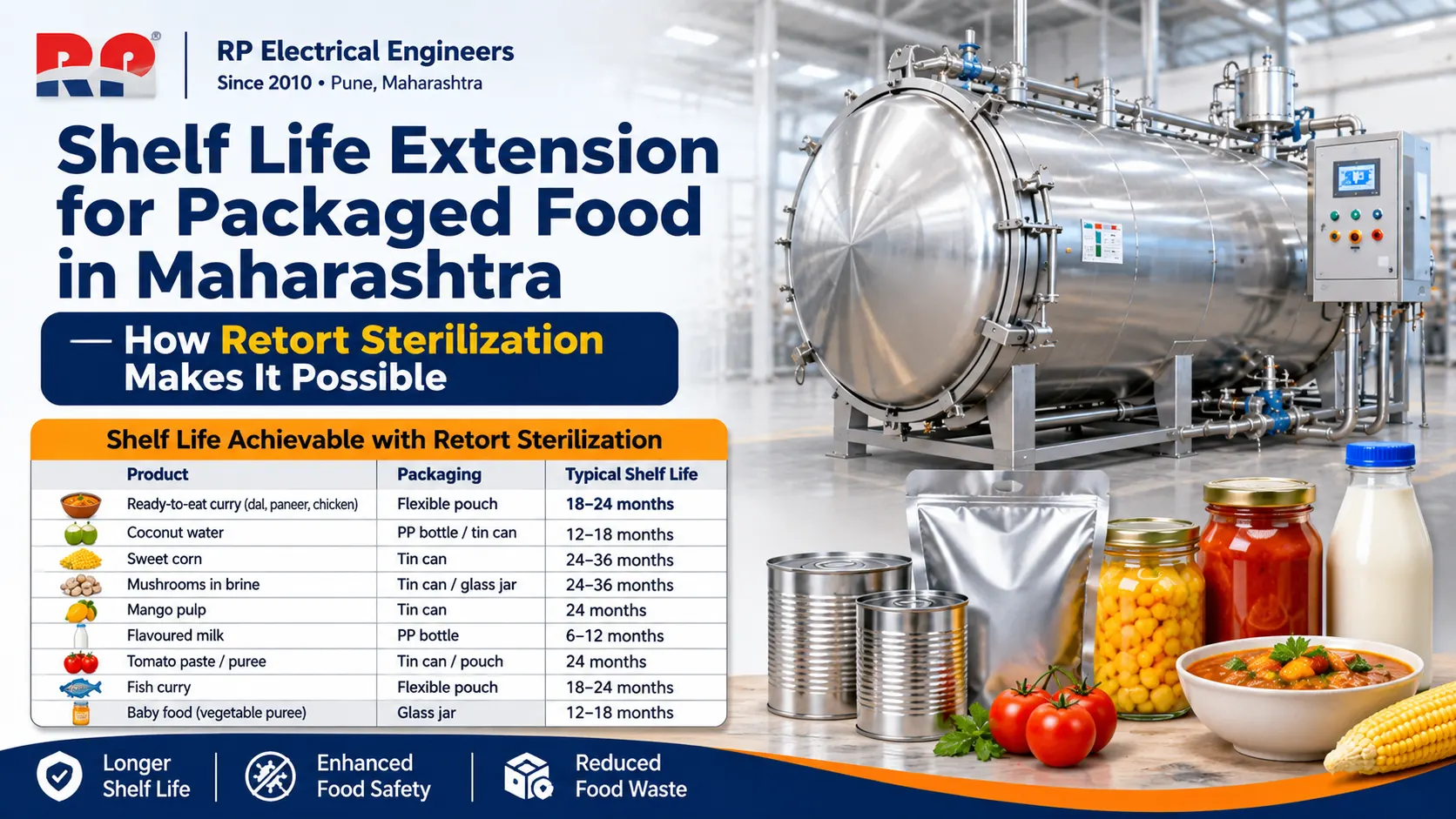
Shelf Life Achievable with Retort Sterilization — Maharashtra Product Examples
| Product | Packaging | Typical Shelf Life |
|---|---|---|
| Ready-to-eat curry (dal, paneer, chicken) | Flexible pouch | 18–24 months |
| Coconut water | PP bottle / tin can | 12–18 months |
| Sweet corn | Tin can | 24–36 months |
| Mushrooms in brine | Tin can / glass jar | 24–36 months |
| Mango pulp | Tin can | 24 months |
| Flavoured milk | PP bottle | 6–12 months |
| Tomato paste / puree | Tin can / pouch | 24 months |
| Fish curry | Flexible pouch | 18–24 months |
| Baby food (vegetable puree) | Glass jar | 12–18 months |
The Role of Packaging in Retort Shelf Life
Retort sterilization destroys the microorganisms inside the package at the time of processing. But the product’s shelf life after retorting depends entirely on the packaging maintaining its seal and barrier properties throughout storage.
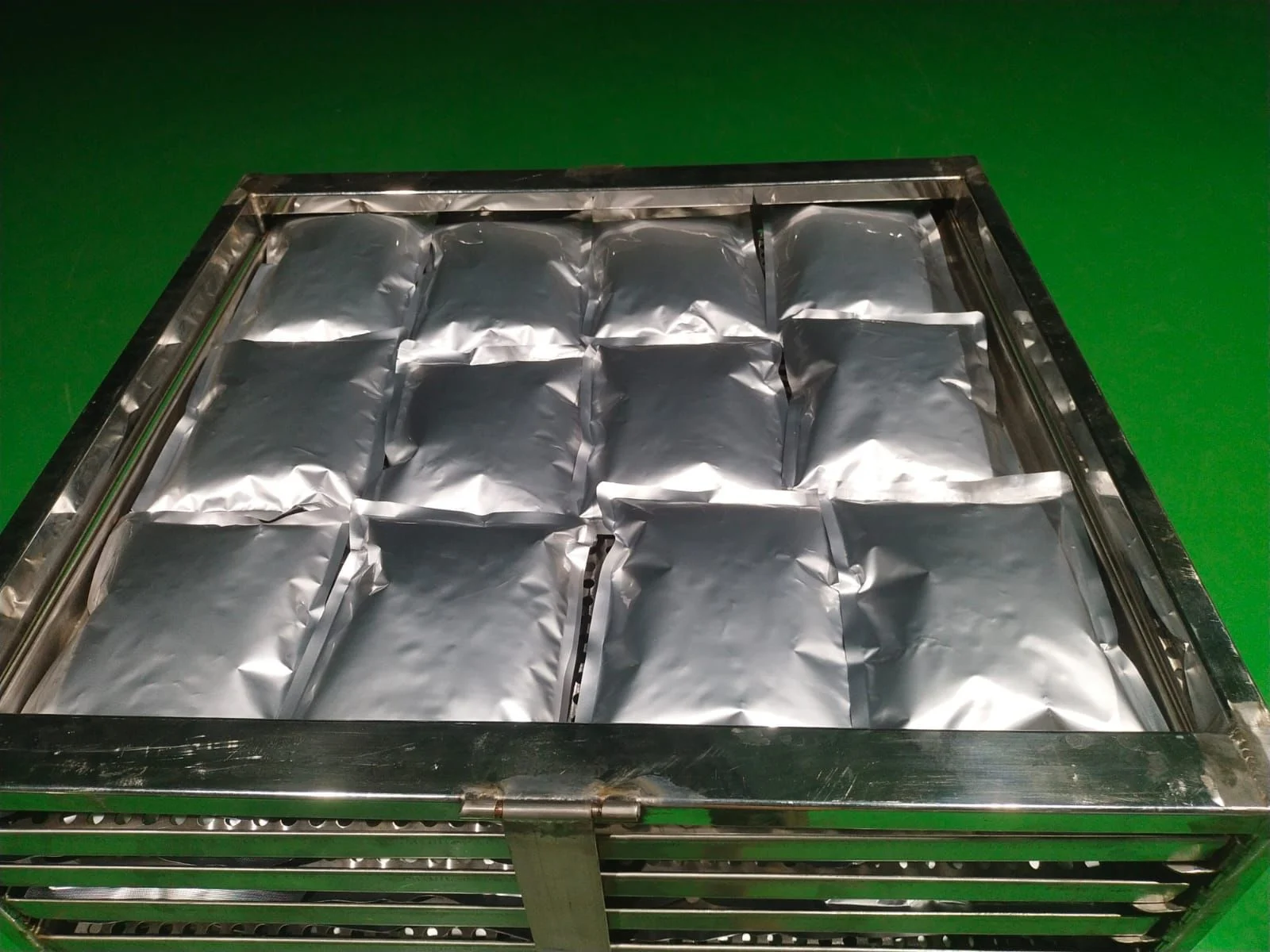
Flexible Retort Pouches
The most popular format for Maharashtra’s RTE food industry. A retort pouch must have:
- Oxygen barrier layer (usually aluminium foil) to prevent oxidation
- Heat-seal layer (CPP — Cast Polypropylene) that forms a reliable, airtight seal
- Structural layers (PET or Nylon) for mechanical strength during retorting
A single seal defect — even a pinhole — will compromise the entire shelf life of the product. This is why pouch seal integrity testing before and after retorting is mandatory.
PP Bottles
Used extensively for coconut water and flavoured milk processing in Maharashtra. The PP (polypropylene) material must be food-grade and rated for retort temperatures. Caps must maintain an airtight seal under the pressure conditions of the retort cycle.
Tin Cans
The most established format, used for Nashik’s sweet corn canning industry and Maharashtra’s seafood processors. The double seam must be properly formed and regularly inspected to ensure integrity after retorting.
Common Shelf Life Problems After Retorting — And How to Prevent Them
Problem: Pouch swelling (“blowing”)
Cause: Insufficient F₀ value — surviving microorganisms produce gas after the retort process.
Prevention: Validate your retort schedule properly. Never deviate from the validated process. Use RP Electrical Engineers’ PLC-controlled retort machines that maintain accurate temperature throughout the cycle.
Problem: Discolouration of product
Cause: Over-processing (too high F₀) causing Maillard browning, or under-processing causing enzymatic browning.
Prevention: Optimise your retort schedule with the guidance of a food technologist. The goal is the minimum F₀ that achieves commercial sterility, not the maximum.
Problem: Loss of texture (mushiness)
Cause: Over-processing or high retort temperature for heat-sensitive products.
Prevention: Use a retort type appropriate for your product. Some products benefit from a lower-temperature, longer-time process. RP Electrical Engineers can advise on the right retort configuration.
Problem: Seal failure during retorting
Cause: Incorrect overpressure setting on the retort machine, or substandard pouch material.
Prevention: Use a retort machine with accurate overpressure control (available on all RP Electrical Engineers pouch retort machines). Use retort-grade pouches from approved suppliers.
Retort vs Other Shelf Life Extension Methods
| Method | Shelf Life | Requires Cold Chain? | Suitable for Curries/Gravies? | Capital Cost |
|---|---|---|---|---|
| Retort sterilization | 12–36 months | No | Yes | Medium |
| Pasteurisation | 2–6 weeks | Yes | Limited | Low–Medium |
| Freeze drying | 2–5 years | No | Yes (with rehydration) | Very High |
| HPP (High Pressure Processing) | 30–90 days | Yes | Yes | Very High |
| MAP (Modified Atmosphere Packaging) | 2–8 weeks | Yes | Limited | Low–Medium |
| Vacuum packing only | 1–4 weeks | Yes | Yes | Low |
For Maharashtra’s food manufacturers targeting national distribution and e-commerce without refrigeration, retort sterilization offers the best combination of shelf life, food safety, cost of equipment, and consumer acceptance.
RP Electrical Engineers — Your Retort Machine Partner in Pune, Maharashtra
Since 2010, RP Electrical Engineers has helped food manufacturers across Pune, Mumbai, Nashik, Aurangabad, Kolhapur and all of Maharashtra achieve the shelf life their products need to compete nationally.
Our retort machines are designed specifically for the demanding conditions of food-grade sterilization:
- Precise temperature control (±0.5°C accuracy) for consistent F₀ delivery
- Automated overpressure control to protect pouch integrity
- PLC-based data logging for FSSAI batch record compliance
- SS-304 construction throughout all food-contact surfaces
- Full installation, commissioning, and training at your Maharashtra facility
Frequently Asked Questions
How long will my product last after retort processing?
This depends on your product type, pH, water activity, packaging, and the F₀ achieved. Most low-acid RTE food products processed correctly achieve 18–24 months. RP Electrical Engineers can help you determine the target shelf life and appropriate retort schedule for your specific product.
Does retort processing affect the taste and nutrition of my product?
All thermal processing has some effect on flavour and nutrients. Retort processing is carefully optimised to deliver the minimum heat treatment needed for commercial sterility, minimising quality loss. Many consumers prefer the flavour of properly retorted curries and gravies to fresh-cooked versions.
Can I use a regular pressure cooker instead of a retort machine for commercial production?
No. A domestic pressure cooker is not a retort machine. It has no temperature monitoring, no pressure control, no data logging, and no way to validate the F₀ delivered. Using a pressure cooker for commercial food production is an FSSAI violation and a food safety risk.
What is the difference between pasteurisation and retort sterilization?
Pasteurisation uses lower temperatures (typically 70–85°C) and achieves partial microbial destruction, requiring cold chain storage. Retort sterilization uses higher temperatures (110–125°C) under pressure and achieves commercial sterility, allowing ambient temperature storage for 12–36 months.
Explore Our Retort Machine Solutions
Interested in our retort machines? Explore our pouch retort machine in Pune, water spray retort machine, and canning retort machine offerings. Ready to discuss your project? get a free quote today.
Related RP Electrical Resources
Explore these related solutions and guides from RP Electrical Engineers: